The week ahead (2026-08-31 to 2026-09-04): an index near its highs, a sentiment gauge at 97, and the August jobs report on Friday, September 4. The market is priced for calm at the very moment the calendar is loaded with the one number most able to break it.
Where the tape sits
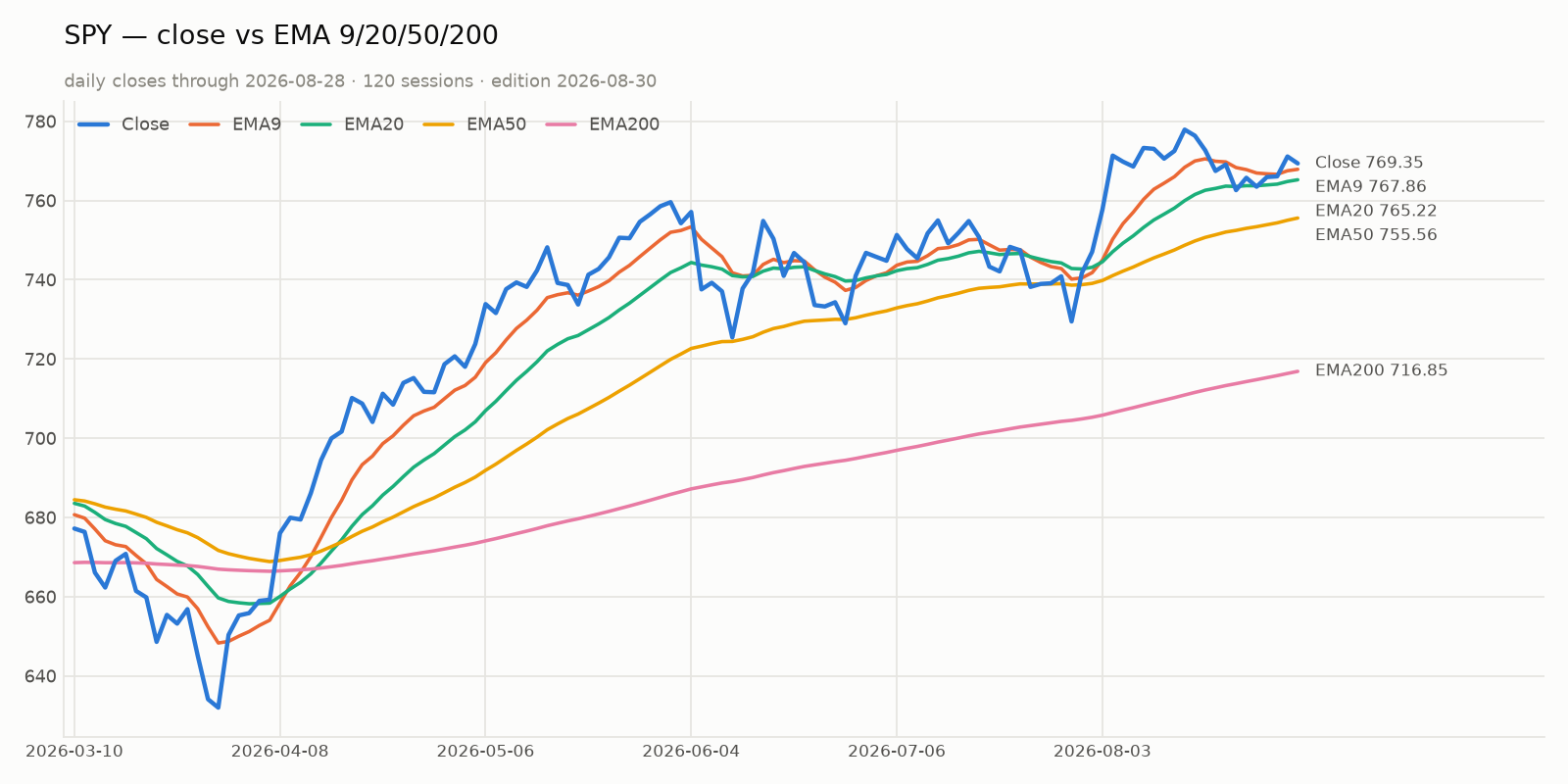
SPY closed at 769.35 on Friday, August 28, above every trend line we track: 0.19% above its 9-day average, 0.54% above the 20-day, 1.82% above the 50-day, and 7.32% above the 200-day [1]. It sits at the 93rd percentile of its one-year range, 1.29% below the August 13 high of 779.37 [1]. Realized volatility over the last 20 sessions is 10.4% annualized, which is a quiet tape [1].
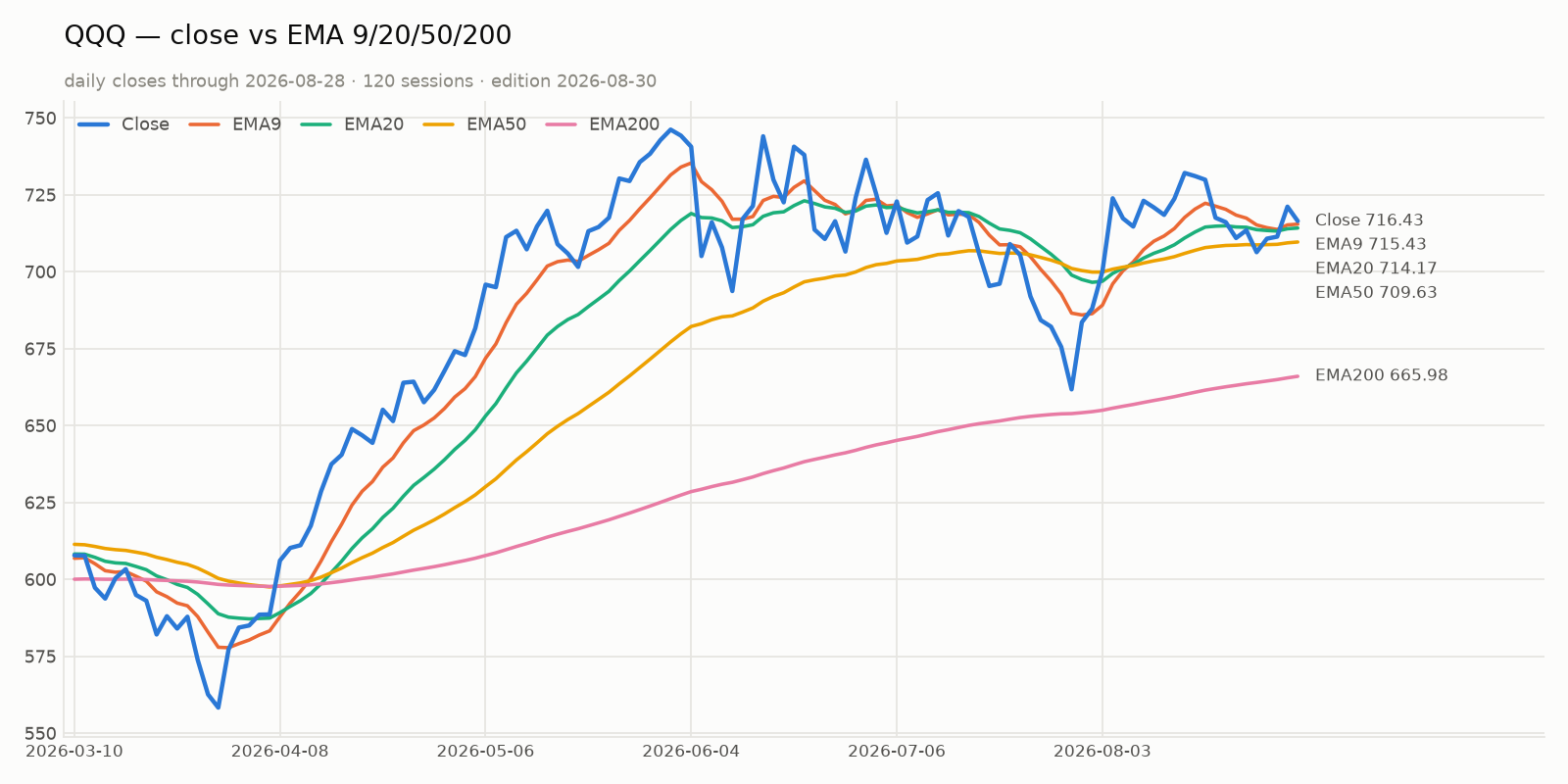
QQQ closed at 716.43, also above all four averages, at the 83rd percentile of its one-year range and 4.3% below its June 3 high of 748.65 [2]. It is the choppier of the two: 20-day realized volatility of 18.23% against SPY's 10.4% [2].
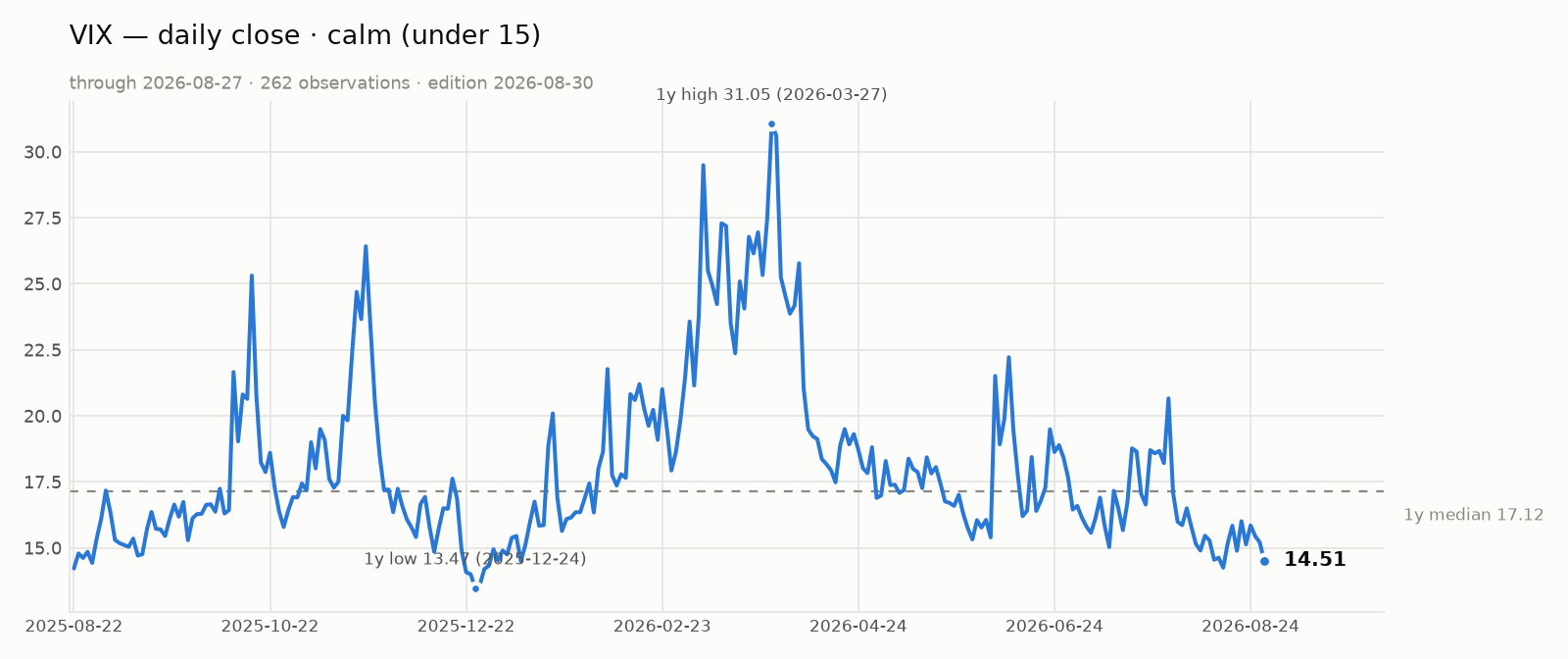
The VIX printed 14.51 on Thursday, August 27, inside our calm band (under 15) and well below its one-year median of 17.125 [3]. Our composite sentiment gauge, which blends volatility, momentum, and distance from the highs into a 0 (washed out) to 100 (frothy) reading, sits at 97.0 [4]. Readings this stretched have historically been poor moments to start new positions: they do not reliably call tops, but they mean you are paying the year's fullest prices for the year's calmest tape.
Treasury yields are the standing tension under all of this. The 10-year at 4.67% and the 30-year at 5.19% (both August 27) are heavy levels for a book like ours, which is concentrated in long-dated growth stories whose value lives years out [5]. The 2-year sits at 4.20% [5].
Dealer positioning
The day's option flow left dealers net short delta in both indexes (SPY roughly -$7.1B, QQQ roughly -$8.0B), with the heaviest strike concentration at SPY 770 and QQQ 720 overhead and 760/710 below [6]. Read: the tape is likely to stay pinned and sticky near those levels, with SPY's gamma flip far below at 694.5, so the amplification zone is nowhere near current prices [6]. Posture context, never a trigger.
The week's events
- Employment Situation, Friday, September 4. HIGH. With the 10-year at 4.67% and our book tilted toward semis, nuclear, and AI infrastructure names that trade on distant cash flows, the jobs number is the week's one release that can move both rates and the growth trade at once [7][5]. A hot print pushes yields toward their July highs; a soft one revives cut hopes. Either way our names move more than the index does.
- Jobless claims, Thursday, September 3. MEDIUM. Same channel, smaller charge [7].
- Fed speeches: Governor Barr Tuesday, September 1; Governor Waller Thursday, September 3. MEDIUM for Waller, LOW for Barr. Waller has been a directional voice on rates; a strong signal from him ahead of Friday's jobs data could front-run the reaction [7].
- Earnings: AVGO reports Wednesday, September 2 (consensus $2.83); PL reports Thursday, September 3 (consensus -$0.18) [8]. We do not hold either: we exited AVGO on August 14 at a loss, and we hold no space names after exiting RKLB on August 25 [9]. AVGO still matters to us indirectly; it is one of 24 names in our semis and semicap bucket, where we hold three (NVDA, COHR, AOSL), and a strong AI-revenue print from it tends to lift the whole group [10].
AI datacenters: the constraint is power, not chips
Dell'Oro raised its datacenter capital-spending forecast to more than $3 trillion cumulative by 2030 [11]. The same week's reporting was all about what stands in the way: eWeek flagged an AI power bottleneck as a risk to Microsoft Azure's growth, Tom's Hardware reported that America's largest grid wants new datacenters above 50 megawatts to be first in line for cutoffs during shortages unless they bring their own generation, and five of six U.S. grid operators asked FERC to delay its datacenter power deadline [11]. Plainly: the buildout's money is committed, but the electricity to run it is now the fight, and the operators of the grid are pushing back rather than accommodating.
That reads as support for two things we own. We hold NVDA (the chips the capex buys) and NBIS and AMZN on the infrastructure side, and our nuclear and uranium bucket, six names of which we hold three (LEU, SMR, UUUU), is a direct bet that datacenters end up paying for their own power [10][9].
Memory: the AI chip's bottleneck gains pricing power
High-bandwidth memory is the stacked memory bolted directly to AI processors; without it the processor starves. SK hynix said its newest generation, stacked 12 layers high, is now in mass production, and Nvidia's CEO denied rumors it was cutting memory allocations, confirming three qualified suppliers [12]. Reporting tied rising memory costs directly to a more than 15% price increase on AI servers notified to the big cloud buyers, with Korean press framing Samsung and SK hynix as gaining pricing power as a result [12]. SK hynix also announced a $38 billion new-factory investment and a $28.6 billion share buyback described as the largest in Korean corporate history [12]. Translation: the memory makers, long the cyclical poor cousins of the chip industry, are now the toll booth on the AI highway, and they know it. Neither Korean name is tradeable for us; the closest listed proxy in our universe, MU, we do not hold. We hold NVDA, which pays those higher memory prices but has so far passed them through [9].
Defense: the Navy opens the door to foreign shipyards
Following the August 13 presidential memorandum on rebuilding naval shipbuilding, the week's coverage detailed the mechanisms: a "Finland Model" letting qualified foreign shipyards build initial hulls if they invest in U.S. yards and transfer technology, a directive to stand up a fifth public Navy shipyard within 120 days (the first new public yard in over 80 years), and analysts warning the plan runs into cost and workforce limits [13]. The Navy also sent the submarine USS Massachusetts straight to fleet duty, skipping its usual post-delivery maintenance period, which one outlet questioned as corner-cutting to speed deliveries [13]. The signal for the trade: shipbuilding demand is being forced through the system faster than the industrial base can absorb it, which is bullish for capacity owners and suppliers even as execution risk rises. Our defense bucket holds four names and we own one, AXON, which is public safety rather than shipbuilding; we do not hold HII or KTOS, and we exited MRCY on August 27 [10][9].
Our book
The book holds 12 positions. Per the packet's own count, 11 sit inside their buy bands and one, AOSL, sits below its band [9]. Marks cluster at or slightly below entry: most names are within about 3% of cost, with UUUU the widest at -7.6% and AMZN flat [9]. The last 30 days were an active reshuffle, 78 realized exits, with COHR, NBIS, and PLPC contributing the large wins and UUUU, AMKR, and RKLB the large losses [9].
How this publication keeps score
Everything we publish stays attached to the dated record that produced it. Each edition is built from a sealed packet of source pulls, each with its own timestamp and receipt, so any claim can be traced back to exactly what was known, from where, and when it was known. The story never floats free of its evidence, and we cannot quietly rewrite what we believed after the fact.
Receipts. [1] Sunday packet 2026-08-30 (sha 3aba0d44), §2 Index state SPY: close 769.35 on 2026-08-28; EMA9/20/50/200 +0.19/+0.54/+1.82/+7.32%; range position 93.3%; high 779.37 on 2026-08-13; 20d realized vol 10.4%. [2] §2 Index state QQQ: close 716.43; range position 83.3%; -4.3% off 748.65 high of 2026-06-03; 20d vol 18.23%. [3] §2 VIX: 14.51 on 2026-08-27; median 17.125; band convention. [4] §2 Fear & Greed: our proxy score 97.0, formula per packet. [5] §2 Treasury yields: DGS10 4.67, DGS30 5.19, DGS2 4.20 (2026-08-27); T10Y2Y 0.39 (2026-08-28). [6] §2b Direction pressure: SPY net DEX -7,131,232,877, flip 694.5333, call/put walls 770/770; QQQ net DEX -8,024,624,183, call wall 720, put wall 715; §2 Options positioning: SPY gex wall 770, put wall 760; QQQ put wall 710. [7] §3 Macro calendar: Barr 2026-09-01, Waller 2026-09-03, claims 2026-09-03, Employment Situation 2026-09-04; weekdays from §0b. [8] §3 Universe earnings: AVGO 2026-09-02 est 2.83; PL 2026-09-03 est -0.18. [9] §5 Our book: position_counts total 12, in_zone 11, below_zone AOSL; marks per position rows; recent_exits including AVGO 2026-08-14, RKLB 2026-08-25, MRCY 2026-08-27; 78 exits in 30d. [10] §3 Sector mix: Semis & semicap n=24; Nuclear n=6; Defense n=4. [11] §4 theme id=78: Dell'Oro $3T by 2030; eWeek Azure bottleneck 2026-08-16; Tom's Hardware 50MW+ cutoffs 2026-08-17; Capacity five-of-six FERC delay 2026-08-24. [12] §4 theme id=76: HBM4 12-layer mass production; Nvidia three suppliers; >15% AI server price increase; $38B fab; $28.6B buyback. [13] §4 theme id=81: Finland Model; fifth public yard within 120 days, first in over 80 years; USS Massachusetts skips shakedown availability.
Disclosure: the machine's book holds AMZN, AOSL, AXON, COHR, HOOD, LEU, NBIS, NVDA, PLPC, SMR, UMAC, UUUU.